
A collaboration between the Human Neuroscience Lab at Boston College and Think Variant

Dr. Jason Geller
Director of the Human Neuroscience Lab at Boston College
Dr. Jason Geller directs the Human Neuroscience Lab at Boston College. He needed a chin and forehead rest for eye tracking work.
He went looking, and kept getting quotes in the thousands of dollars.
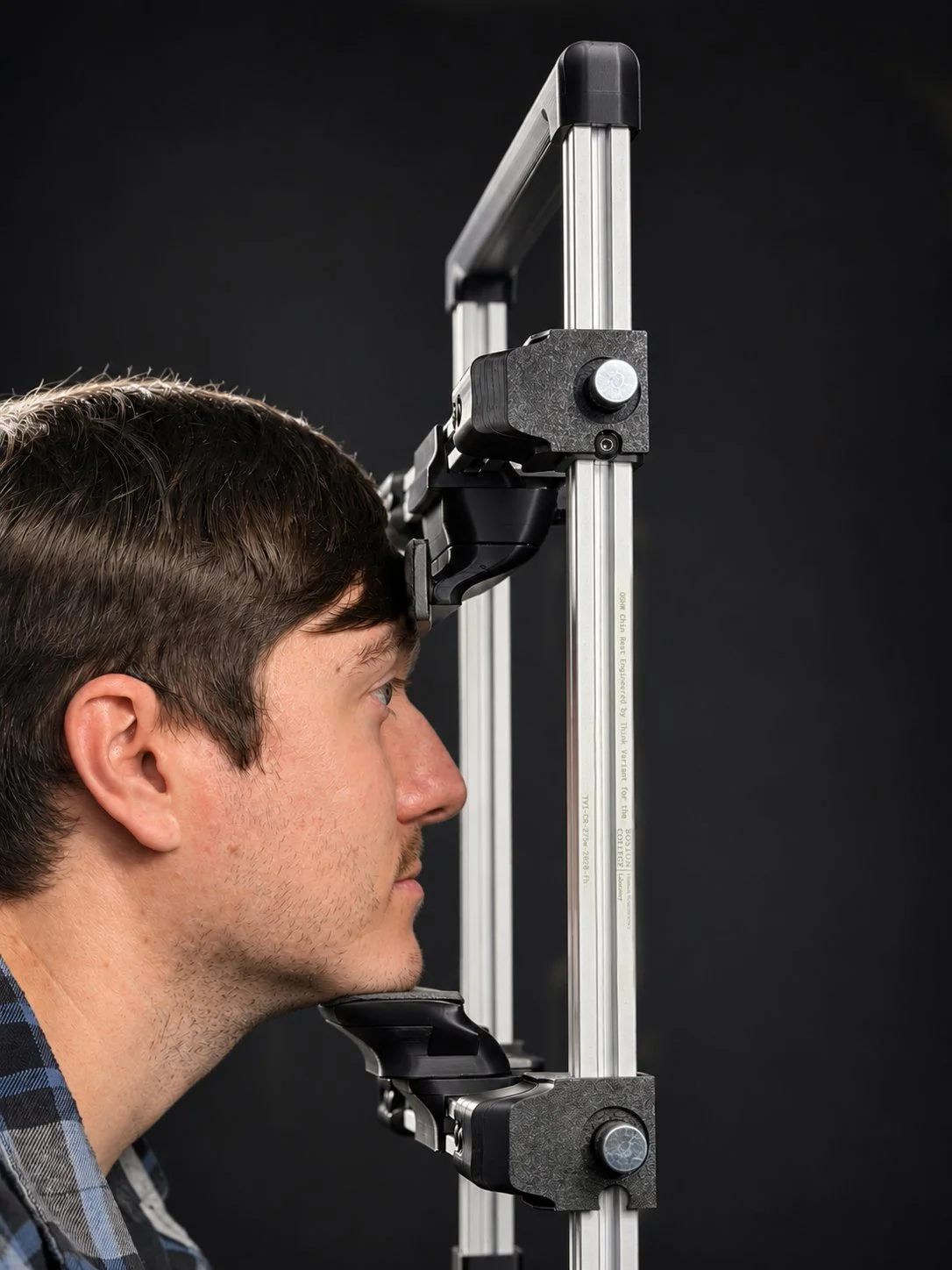
A chin rest holds a head still while you measure something else. The design is about two centuries old. It is a frame, two posts, and two pads.
When Dr. Geller came to us his question was essentially “Is there something about these devices I am missing that makes them so expensive?” We were confused and curious too, so we went looking for that answer and could not find good one.
We hold harder things than this for a living
Think Variant builds jigs and fixtures. We hold drone assemblies and automotive components and parts with tolerances a human head does not have.
A person sitting still at a bench is not a difficult holding problem. It is one of the easier ones we have been handed.
From first principles there is no engineering reason this device costs what it costs. So we solved it.
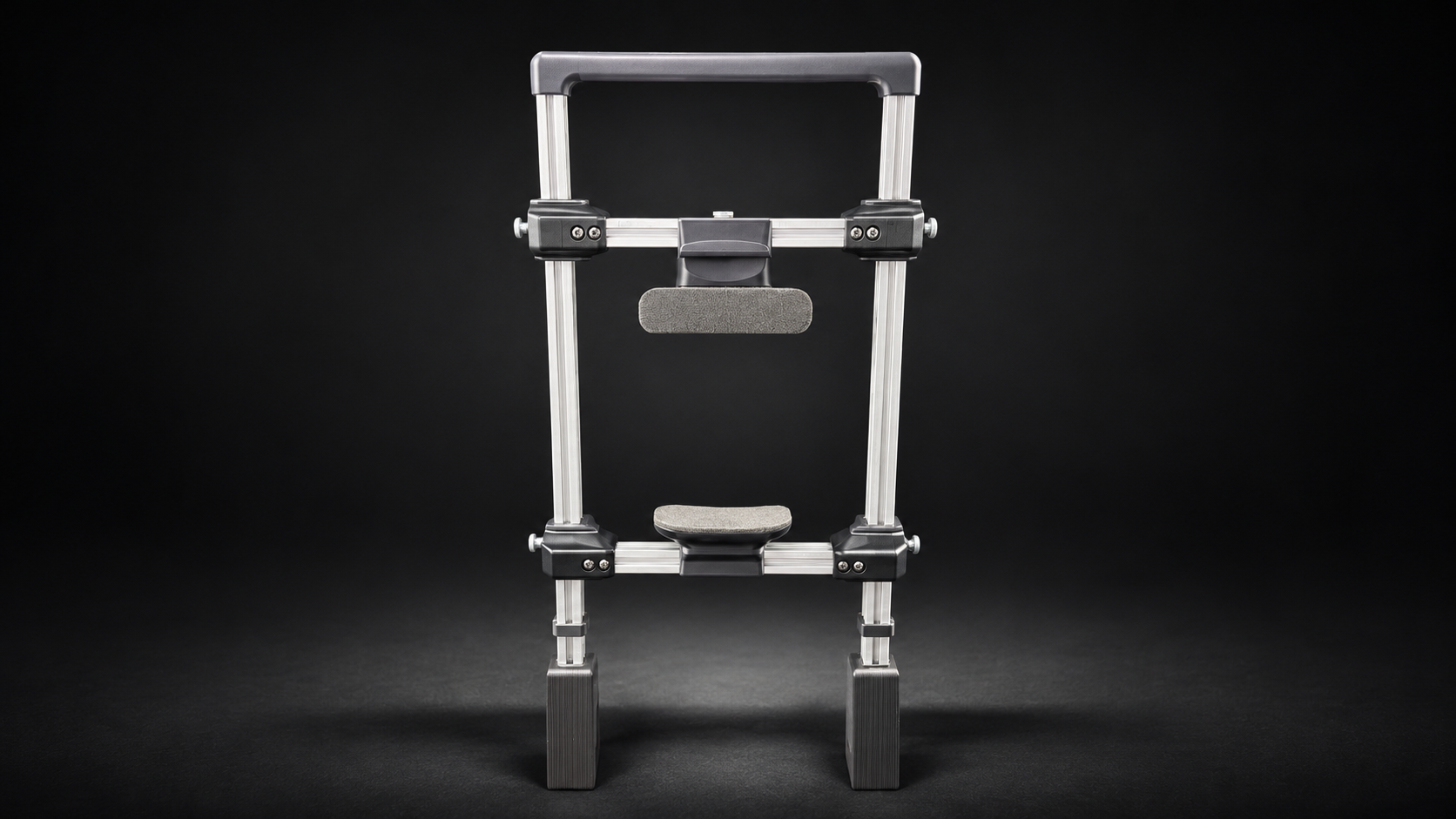
The OSHW Chin Rest developed by Think Variant and The Human Neuroscience Lab at Boston College
Why it is free
Think Variant exists because of open source hardware.
In 2020 our founders worked the face shield response. Stephanie and Isaac Budmen designed and open-sourced a face shield design. Harold Watkins and Scott Antonacci took the Budmen design, adapted it for injection moulding, cut a mould, and shot six hundred pieces in four days. The volunteer network around that one free open-source design self-reported three and a half million units. The company was founded the next year out of that work.
Our mission is to accelerate the rate of human innovation. Researchers are the people doing that. Charging them thousands of dollars for a bracket is a tax on the exact thing we say we care about.
So the CAD is free and the bill of materials is published in full. Nobody has to ask us for permission, or for a price.
Three ways to get one
1. Print it yourself.
The parts are designed for FDM. You pay for filament and hardware. That is the whole cost.
2. Send it to a print service.
Any local shop can run these files. The published BOM means you buy the hardware yourself and know exactly what you are getting.
3. Ask us to build it.
If you would rather not spend the week, we will make one and check it before it ships.
The first option is real. This is not a funnel.
What is the OSHW Chin Rest?
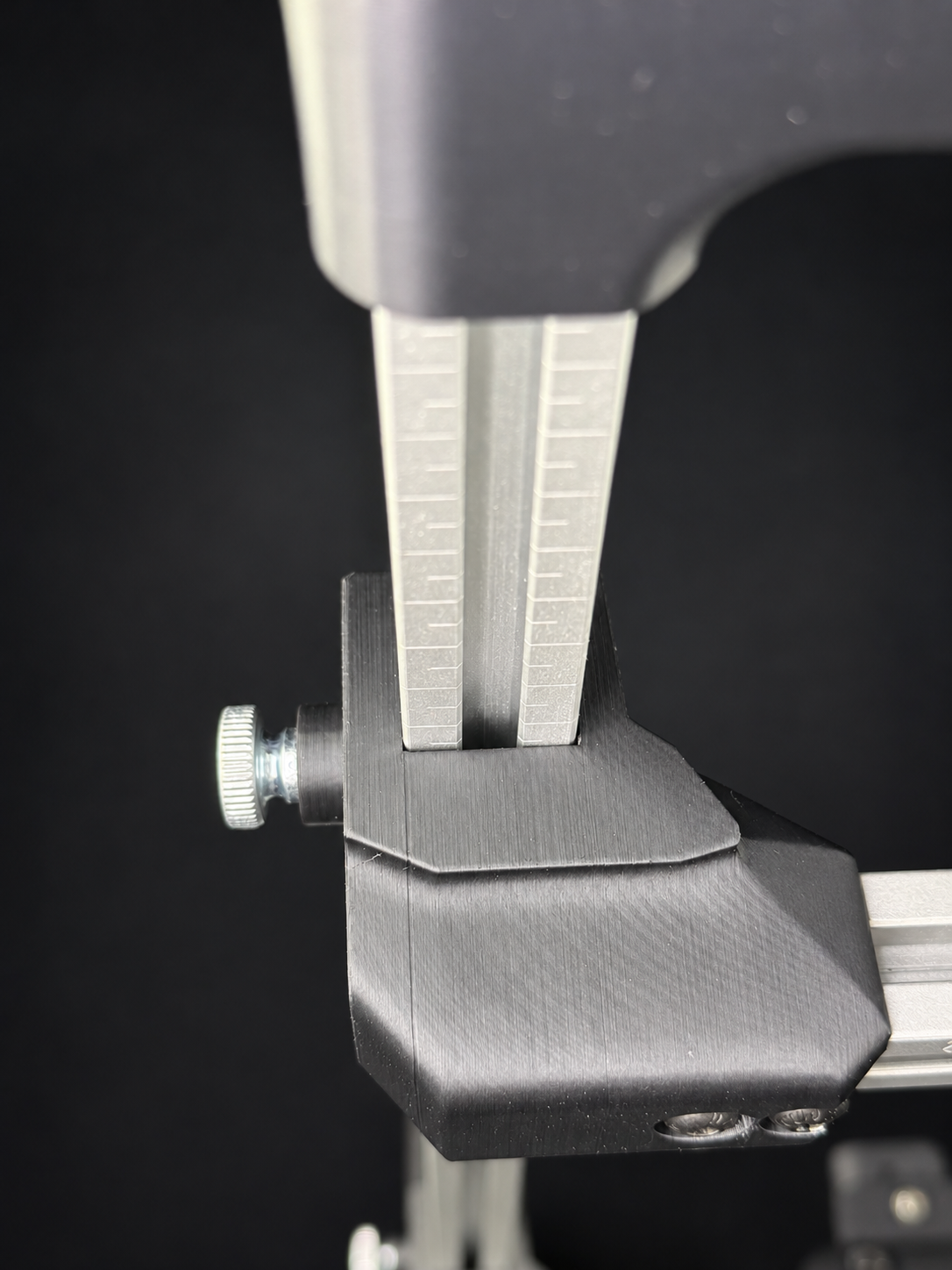
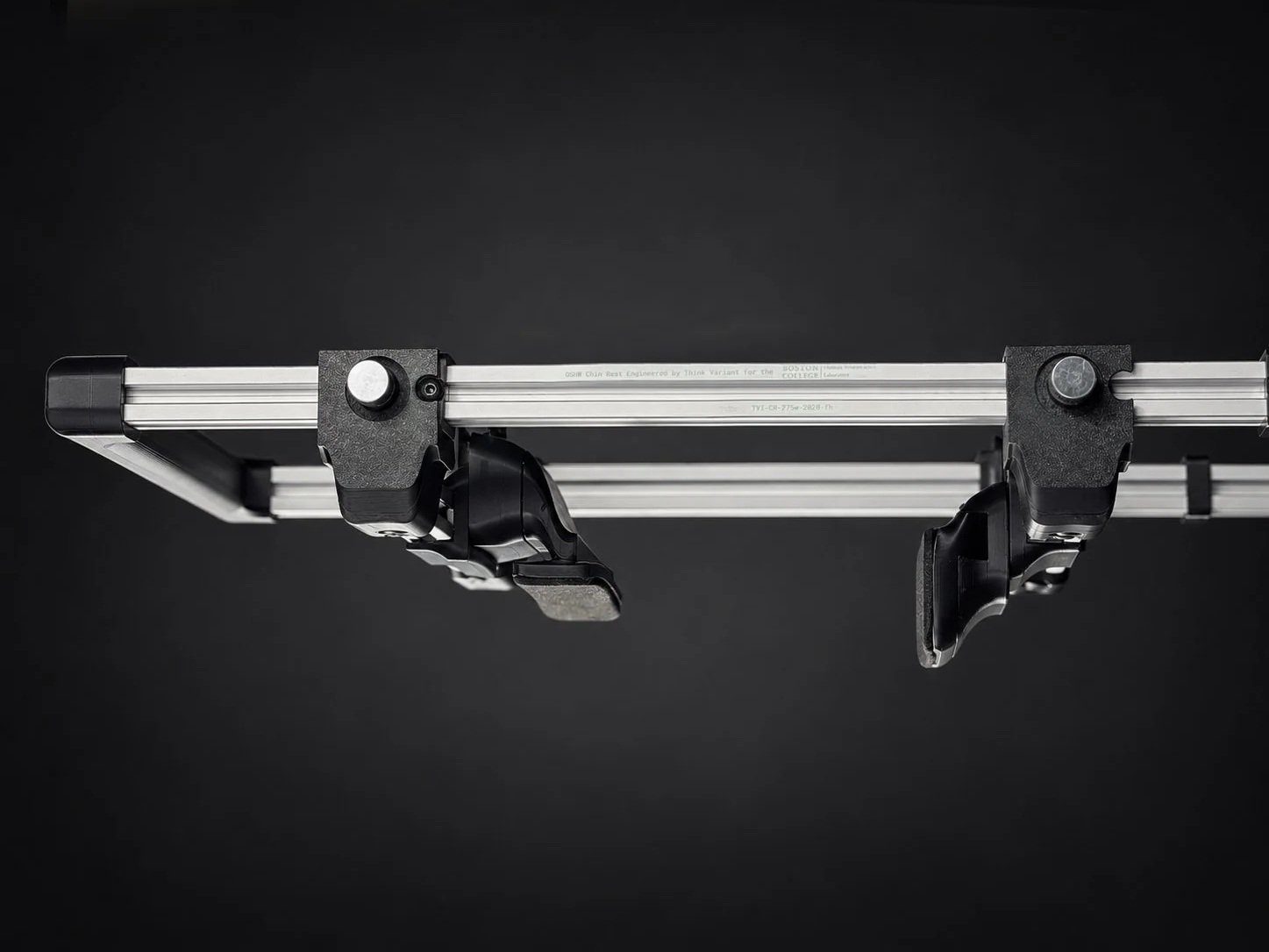
Two uprights made of 20 by 20 mm aluminium extrusion, carrying two crossbars. M5 hardware throughout. All of the components are available from any extrusion supplier.
The chin station and the forehead station mount separately and adjust independently. Height at both posts, and adjustability forward and back for depth.
Both contact faces take a 3mm neoprene pad that comes off for cleaning and replacement. No screw passes through either pad. Flat cutting patterns are in the download so a lab can cut its own.
The printed parts carry the mechanisms and every surface a participant touches. The metal is deliberately ordinary.
What is in the design package?
Seventeen printable files, making 28 printed pieces for one two-level fixture.
Editable STEP parts and assemblies, so this is a starting point rather than a sealed box.
The full bill of materials. Fifteen purchased hardware lines, three pad and consumable lines, every fastener and T-nut counted.
Neoprene cutting patterns for both pads.
Revision notes, so the reasoning travels with the geometry.
What will it cost to make one?
We expect most people building one to spend approximately $250–$350 in materials, depending on where they source their components and what they already have on hand.
That does not include the cost of 3D printing or fabrication services if you hire a shop to make the parts. Those costs will vary depending on the provider, material, and equipment used.
The material estimate covers aluminum extrusion, fasteners, threaded inserts, neoprene, and printing filament. Suppliers change their prices, hardware comes in different package quantities, and ordering extrusion cut to length may cost more than cutting it yourself. The full bill of materials is published so you can shop around.
There are 28 printed pieces in the complete assembly. Depending on your printer, material, and settings, we would plan for approximately 40–80 hours of total printing time. That does not mean 80 hours of labor. It means several print jobs running over a few days. Faster machines can shorten that considerably.
For someone comfortable with FDM printing and basic mechanical assembly, allow another 1–4 hours of hands-on work to prepare the parts, install the threaded inserts, fit the hardware, cut the neoprene pads, and assemble and adjust the frame. Your first build may take longer.
You do not need a machine shop. A capable FDM printer, a way to install heat-set inserts, and ordinary hand tools will get you most of the way there. Order the extrusion cut to length and the fabrication becomes simpler still.
Help us finish it
This is version one, and we are publishing it now on purpose.
The engineering is done. The geometry is resolved, the fits are checked, the parts print, and the bill of materials is real.
What comes next is the part we cannot do alone. A load and fatigue programme. Real sessions with real participants. The kind of human factors feedback that only turns up in the fourth hour on somebody else’s bench.
A free design sitting in a hundred labs gets stressed harder than one sitting in our shop, and gets better faster.
So print it, set it up, and use it. It positions a head, the way chin rests always have, and a participant can lift away from it at any time. Check your own prints, trust your own bench, and tell us what moves.
The most useful thing you can send us is the thing that did not work.
Make One Today
Build it. Change it. Make it better. (If you do, tell us, and then publish that too!)
